Organic Black Rice: Karuppu Kavuni, Benefits and How to Cook It
A practical guide to Tamil Nadu’s traditional black kavuni rice, its dark bran, kitchen uses and patient cooking
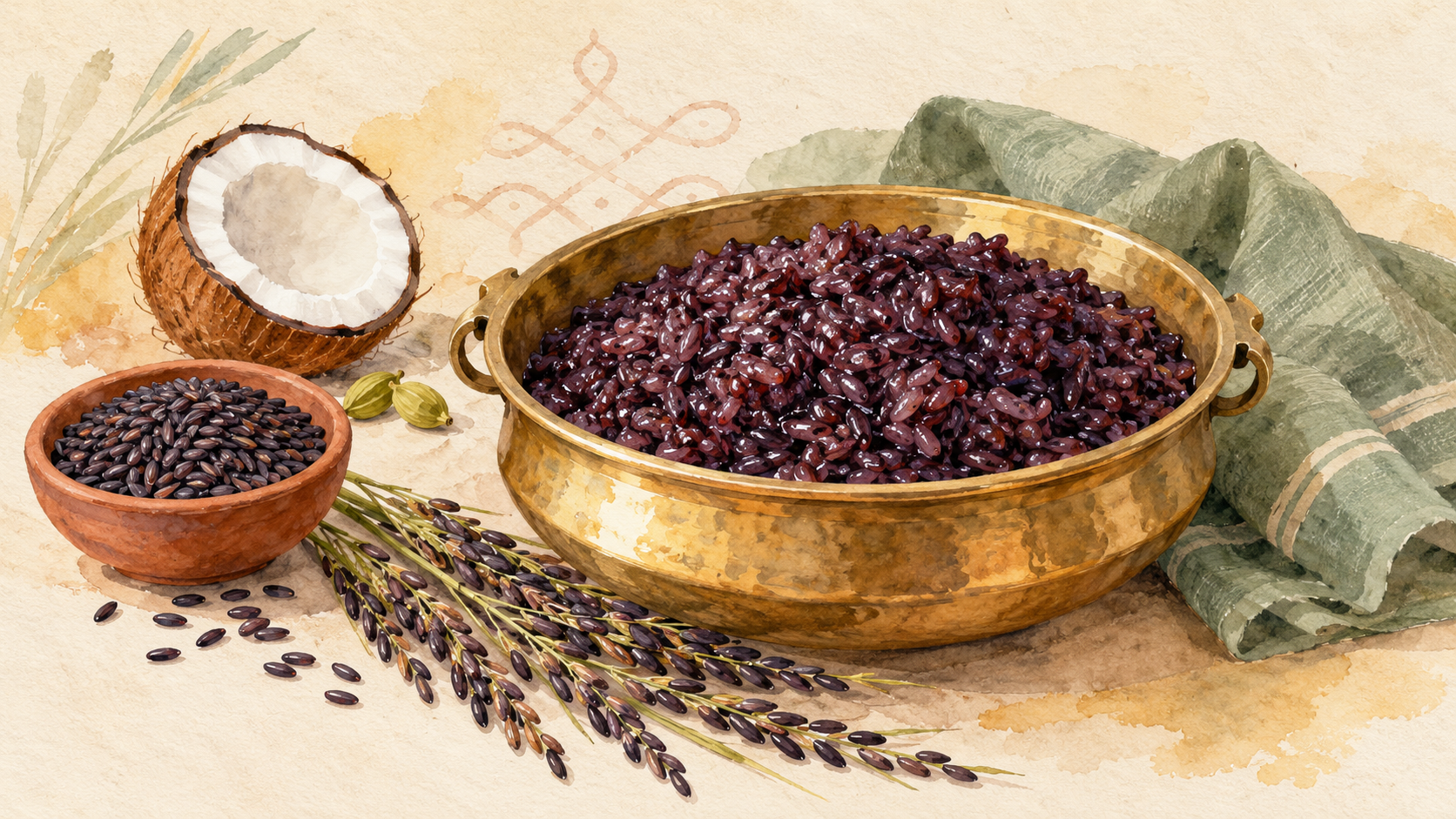
Organic black rice is a whole-grain rice valued for its naturally dark bran, gently nutty flavour and pleasantly chewy texture. In Tamil Nadu, one of its most meaningful expressions is Karuppu Kavuni—also written as black kavuni or kowni rice—a traditional paddy variety remembered as much for festive sweets as for its deep purple-black colour.
It deserves a place in the kitchen, but not a halo. Black rice provides starch like every rice. Its distinctive advantage is the pigmented outer layer, which contains anthocyanins and other plant compounds. The practical way to enjoy it is as a flavourful whole grain, cooked well and served in a balanced portion—not as a cure or a licence to ignore the rest of the meal.
What is organic black rice?
Black rice is a group of pigmented varieties of Oryza sativa. The uncooked grains may look black, charcoal or deep indigo; when cooked, they usually become purple-burgundy because their bran contains water-soluble anthocyanin pigments. These are the same broad family of pigments that colour foods such as jamun, black grapes and purple cabbage.
Most black rice sold as a whole grain retains its bran and germ. That gives it a firmer bite and fuller flavour than polished white rice. “Organic” describes how the crop is cultivated and certified; it does not mean the grain has no carbohydrate or that portions no longer matter.
Karuppu Kavuni: Tamil Nadu’s traditional black rice
Karuppu means black in Tamil, while Kavuni is the variety name. Spellings such as kavuni, kavuni arisi and kowni appear in English, but they refer to the familiar black rice associated with Tamil kitchens.
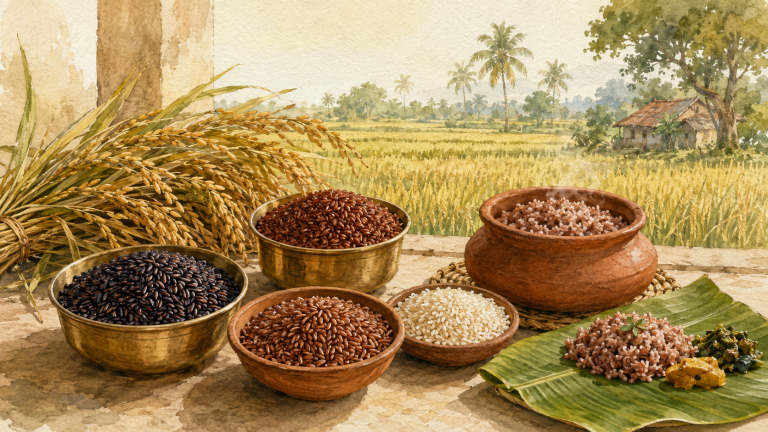
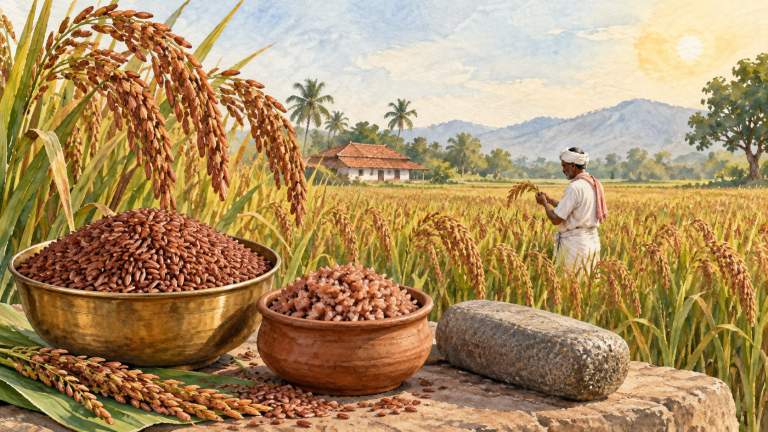
Tamil Nadu Agricultural University records Karuppu Kavuni among the state’s traditional rice varieties and documents cultivation extensively. Its traditional description notes a long crop duration of roughly 150–170 days, suitability for the September-to-January season, profuse tillering and use in sweets with coconut milk. This long field cycle is one reason heritage grains cannot always be compared with modern high-yield rice only by price or output.
The Tamil Nadu government has also included Karuppu Kavuni in the Nel Jayaraman Traditional Rice Varieties Conservation Mission, alongside varieties such as Thooyamalli, Seeraga Samba and Mappillai Samba. That matters because a heritage grain remains alive only when farmers can continue to obtain true seed, cultivate it and find a market for the harvest.
Karuppu Kavuni is especially loved as kavuni arisi sweet: soaked and softly cooked rice mixed with coconut and a sweetener. Families vary the preparation with coconut milk, grated coconut, cardamom or ghee. Its dense, chewy grain and earthy sweetness also work in porridge, puttu, dosa batter and modern grain bowls.
What makes black rice nutritionally different?
The colour sits mainly in the bran
Research on pigmented rice identifies anthocyanins—particularly cyanidin-3-glucoside—as important contributors to black rice colour. Studies comparing whole black rice with its bran find that much of the grain’s measured anthocyanin and phenolic content is concentrated in that outer layer. This is why heavy polishing changes more than appearance: it removes much of the pigmented bran.
It brings whole-grain texture and fibre
Because the bran is retained, black rice generally offers more fibre and a more substantial texture than highly polished white rice. Exact nutrition varies by variety, soil, processing and cooking, so packet labels and product-specific analysis are more useful than universal internet numbers.
Promising compounds are not clinical promises
Laboratory and animal research on anthocyanins is extensive, but human studies of pigmented rice remain limited and varied. A systematic review of controlled trials found some promising cardiometabolic signals, yet the studies used different rice varieties, forms, amounts and participant groups. It is therefore more accurate to say that black rice contributes useful plant compounds within a varied diet than to claim that it prevents or treats a disease.
Is black rice low GI?
Not necessarily. Grain variety, milling, soaking, cooking time, cooling, reheating and the foods eaten alongside it can all change the blood-glucose response. Retained bran and a firm texture may slow digestion compared with a more polished, very soft rice, but “black” is not a guarantee of a low glycaemic index.
If you monitor blood sugar, begin with a modest cooked portion and build the plate around vegetables plus dal, curd, egg, fish or another suitable protein. A kavuni sweet made with jaggery is still a sweet: jaggery, coconut sugar and unrefined sweeteners still contribute sugar. People with diabetes should use their own glucose response and professional advice rather than relying on colour alone.
How to cook whole Karuppu Kavuni rice
Karuppu Kavuni is firmer than everyday polished rice. Soaking gives the grain time to hydrate and makes the final texture more even.
- Rinse briefly: Wash 1 cup of rice two or three times. Avoid vigorous repeated washing, which can carry away some of the water-soluble colour.
- Soak: Cover generously with water for 6–8 hours or overnight, then drain. A shorter soak is possible, but cooking will take longer.
- Pressure cook: Add about 2½–3 cups fresh water and cook until the grains are fully tender. Depending on the cooker and the age of the grain, this is often around 5–7 whistles followed by natural pressure release.
- Rest and adjust: Let it stand for 10 minutes. For a salad or savoury bowl, aim for separate tender grains; for porridge or sweet, add more water and cook softer.
Cooking times are guides, not rules. Traditional varieties vary naturally between harvests. If the centre remains chalky, add hot water and continue cooking instead of serving the grain half-done.
Three South Indian ways to use it
Simple Kavuni arisi sweet
Serves 4 | Soak 6–8 hours | Cook about 35–45 minutes
- 1 cup Karuppu Kavuni rice, soaked
- 2½–3 cups water
- ½ cup grated coconut or thick coconut milk
- Jaggery to taste
- ¼ teaspoon cardamom powder
- 1 teaspoon ghee, optional
Pressure-cook the soaked rice until very soft. While it is warm, lightly mash a portion to bind the grains. Stir in grated coconut, cardamom and jaggery. If using jaggery with visible sediment, dissolve it separately in a little hot water and strain it first. Return the mixture to low heat only briefly; finish with ghee if desired. Serve warm or at room temperature.
Savoury bowl
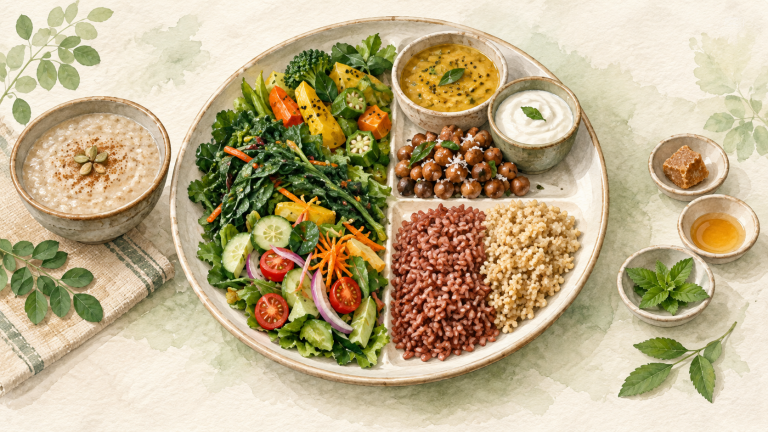
Pair cooked kavuni rice with a generous helping of poriyal or keerai, a ladle of sambar or kootu and a spoon of curd. The grain’s nutty flavour is particularly good with pumpkin, cowpea, horse gram, mushrooms and sesame.
Puttu, dosa and quick breakfast forms
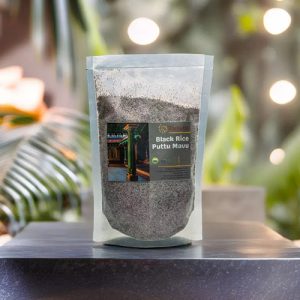
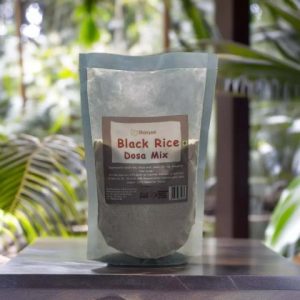
Black rice flour or puttu flour makes it easier to bring the grain into breakfast. Broken kavuni rice can become upma or kanji; aval can be softened for a coconut-lime poha; and puffed black rice adds crunch to a snack mixture. These forms cook differently and may contain other ingredients, so follow the packet method.
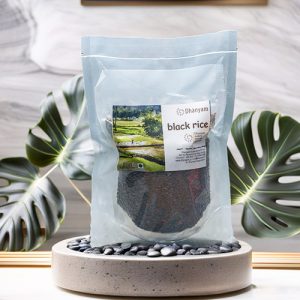
Explore organic black rice at Dhanyam
Start with whole raw Karuppu Kavuni for the traditional sweet or a savoury grain bowl. The boiled version is another whole-grain option, while puttu flour and dosa mix offer convenient South Indian preparations. Availability can vary by delivery location.
How to choose and store it
- Choose grains with an even dark colour and a clean, dry aroma; natural shade variation is normal.
- For the fullest whole-grain character, look for rice that retains its dark bran rather than a heavily polished grain.
- Keep it airtight in a cool, dry cupboard. In a hot or humid kitchen, refrigerating the grain helps protect it from insects and rancidity.
- Buy a quantity you can use while fresh. Whole grains contain natural oils in the bran and do not keep indefinitely.
The bottom line
Organic black rice is worth exploring for its flavour, colour and whole-grain character. Karuppu Kavuni adds something deeper: a living connection to Tamil Nadu’s seed heritage and sweet-making traditions. Cook it patiently, keep its bran, pair it thoughtfully and enjoy it as food—not medicine.
Further reading
- Tamil Nadu Agricultural University: Karuppu Kavuni traditional variety
- Tamil Nadu Agriculture Budget 2023–24: Nel Jayaraman Traditional Rice Varieties Conservation Mission
- Food Chemistry review: black rice composition, properties and processing
- Systematic review of controlled trials on pigmented rice and cardiometabolic risk factors