Turmeric Adulteration: What May Be Hiding in Your Haldi?
Turmeric is so familiar that we rarely pause before adding it to food. Its colour is expected to be bright, its price is expected to be modest, and a packet may remain in the kitchen for months. Those same expectations can make turmeric vulnerable to poor-quality handling and adulteration: an unnaturally vivid colour can be mistaken for strength, while a finely ground powder gives the buyer few visual clues about what went into it.
Good turmeric should be exactly what its name promises: clean, mature rhizomes of Curcuma longa, properly cured, dried and ground. It should not need artificial colour, cheap filler or unsafe chemicals to look golden or remain saleable.
Why turmeric is vulnerable to adulteration
Turmeric moves through several stages before reaching the kitchen. Rhizomes are harvested, cleaned, cured, boiled, dried, polished, stored, traded and often ground far from the farm. Each additional handler can make traceability weaker. Once turmeric becomes powder, colour and texture can be altered more easily and the original rhizome is impossible for a consumer to inspect.
Commercial pressure creates the temptation to:
- make pale or poor-quality turmeric look brighter;
- increase weight with inexpensive powders;
- hide old, damaged or badly stored material;
- protect stocks from insects using poorly controlled chemicals;
- blend many origins without disclosing their quality.
None of this means every conventional turmeric is adulterated. Many farmers, mills and spice businesses follow responsible practices. The concern is greatest when a supply chain is anonymous, price-driven and difficult to verify.
Common adulterants found in turmeric powder
FSSAI’s guidance for the spice sector identifies several possible adulterants in turmeric powder, including coloured sawdust, lead chromate, metanil yellow, chalk or yellow soapstone powder and added starch. They do not all carry the same risk, but none belongs in pure turmeric.
Lead chromate
Lead chromate is a bright yellow industrial pigment. It may be added to make low-grade turmeric appear more attractive. This is particularly serious because lead is toxic: repeated exposure can harm the nervous system, kidneys, blood and cardiovascular system, and children are especially vulnerable. A beautiful yellow colour is never worth a heavy-metal risk.
Indian standards require turmeric powder to test negative for lead chromate. Research in South Asia has shown that lead-chromate adulteration is a real public-health problem rather than an imaginary internet warning.
Metanil yellow and other artificial dyes
Metanil yellow is a non-permitted synthetic colour associated with food adulteration. Other undeclared dyes may also be used to intensify a faded powder. Turmeric naturally ranges from yellow through deep orange according to variety and processing; it does not need to look fluorescent.
Starch, chalk, soapstone and coloured fillers
Added starch can increase bulk and soften flavour. Chalk, soapstone, earth or coloured sawdust can increase weight while imitating turmeric’s appearance. Such dilution lowers the amount of genuine turmeric in every spoonful. It may also introduce physical or chemical contamination depending on the filler and its source.
Spent or exhausted turmeric
Turmeric from which valuable constituents have already been extracted may retain fibre and colour but little aroma or flavour. When this material is mixed into ordinary powder without disclosure, consumers pay for turmeric that has already given up much of its character.
Storage chemicals: a separate but important concern
Adulteration is the deliberate substitution or addition of undeclared material. Chemical use during cultivation or storage is another important food danger which must be noted by consumers. Especially those, who use turmeric raw for medicinal purposes.
Dried turmeric must be protected from dampness, mould, insects and rodents. Conventional warehouses may use fumigation to control storage pests or microbial treatments to improve safety. Authorised treatment, correct dosage, exposure time, aeration, record-keeping and residue compliance are essential. The Spices Board’s turmeric guidance says that insecticide should never be applied directly to dried turmeric and that any fumigation of stored turmeric should be performed by authorised people. But these regulations are seldom followed in the country, sometimes resulting in indiscriminate use of chemicals for storage and to prevent pests.
Problems arise when pesticides or fumigants are used casually, applied directly to the spice, used at the wrong concentration, or employed without respecting safety and ventilation requirements. A consumer cannot see or smell every possible residue. That is why organic turmeric and turmeric powder provide a safe option.
What good storage looks like
Safe storage begins without chemicals:
- dry turmeric to a safe moisture level before packing;
- keep bags off the floor and away from damp walls;
- use clean, dry, pest-resistant storage areas;
- prevent insect and rodent access;
- keep old and new lots identified and separate;
- inspect stock regularly and remove damaged material;
- use sunlight, hygiene and physical controls where suitable;
- if an authorised treatment is necessary, document and control it professionally.
Organic handling narrows the list of permitted inputs and encourages preventive practices, but organic turmeric can still become mouldy or contaminated if it is dried or stored badly. Certification must be supported by competent post-harvest care.
Does organic turmeric contain more curcumin?
Organic turmeric can be an excellent route to flavourful, carefully grown turmeric, but the organic label by itself does not guarantee a higher curcumin percentage.
Curcumin is the best-known member of turmeric’s curcuminoid family and contributes to its colour and biological activity. Its concentration is influenced strongly by:
- variety and genetics: some cultivars naturally contain much more curcumin than others;
- growing region and soil;
- rhizome maturity at harvest;
- curing, drying and grinding conditions;
- storage time, moisture, light and heat;
- whether the powder is diluted or adulterated.
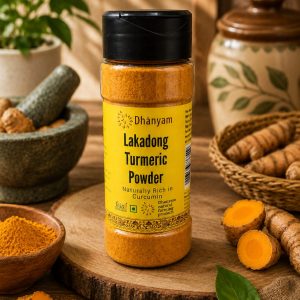
Lakadong turmeric is a useful example of the importance of variety. Scientific analyses have reported markedly higher curcuminoid levels in authentic Lakadong samples than in several other geographical types. That advantage comes primarily from genetics and place, not merely from the word “organic.”
Organic cultivation may contribute indirectly to quality when it is part of a careful system: sound planting material, living soil, patient crop maturity, prohibited synthetic pesticides avoided, separate handling and direct sourcing. A pure organic powder also avoids the obvious dilution of curcumin caused by starch or fillers.
Colour is not a curcumin test
A darker orange turmeric may contain more curcuminoids than a pale sample, but visual colour alone cannot establish curcumin content. Variety, particle size, lighting, moisture and processing all affect appearance—and artificial dyes can make adulterated powder look exceptionally bright.
Likewise, strong staining of fingers, instant colour in water or a yellow oil layer does not prove either purity or high curcumin. Turmeric is naturally a powerful pigment. Proper curcuminoid measurement requires validated laboratory analysis.
Whole turmeric or powder: which offers more assurance?
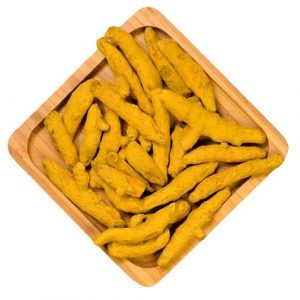
Whole dried fingers allow the buyer to inspect the characteristic shape, internal colour, aroma and visible damage. They are harder to bulk out with starch or sawdust. Buying whole turmeric from a known source and grinding small quantities can therefore reduce some forms of substitution.
Powder is convenient and can be completely trustworthy when the producer controls the rhizome source and milling. The advantage is not “whole good, powder bad”; it is that a powder demands more confidence in the people who made it.
Can turmeric adulteration be tested at home?
Some simple observations may reveal an obvious problem, but they cannot certify purity:
- A musty, chemical or strangely flat smell is a reason not to use the product.
- Visible grit, insects, damp clumps or mould are unacceptable.
- Suspiciously neon colour or colour that separates immediately may justify further investigation.
- Crude water-settling tests can show insoluble matter, but genuine turmeric itself contains insoluble plant material.
FSSAI publishes analytical methods for lead chromate, metanil yellow, dyes and chalk, but some require concentrated acids or laboratory reagents. Do not reproduce corrosive-acid tests casually in a home kitchen. A negative home test cannot rule out sophisticated adulteration, pesticide residues, heavy metals or microbial contamination.
How to choose better turmeric
- Know the source. Look for a producer who can identify the farm or farmer group, variety and processor.
- Prefer certified organic when avoiding prohibited synthetic farm inputs matters to you. Check that the certification applies to the product, not only the shop.
- Ask what “high curcumin” means. Is it based on Lakadong or another named variety? Is a measured percentage available?
- Value aroma and taste over fluorescent colour. Genuine turmeric should smell warm, earthy and distinctive.
- Buy a practical quantity. Repeatedly opening a large packet exposes it to air and kitchen moisture.
- Store it well. Use an airtight, dry container away from sunlight and stove heat, with a clean dry spoon.
- Do not rely on one viral home test. Traceability, standards, good processing and laboratory checks work together.
Dhanyam’s turmeric choices
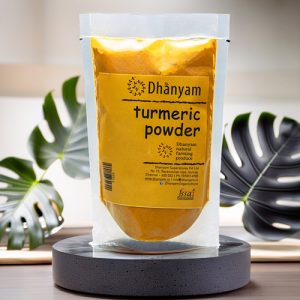
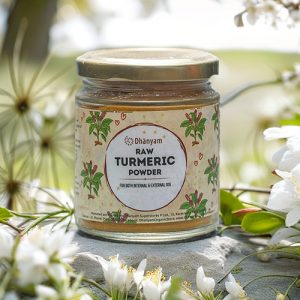
Dhanyam offers turmeric in several forms so that the choice can match the intended use: whole organic turmeric for customers who prefer to grind or inspect the rhizome, everyday organic turmeric powder, raw turmeric powder, and organic Lakadong turmeric selected for a naturally high-curcumin varietal tradition.
The central assurance is not colour enhancement. It is continued work with known sources, organic handling and products that are expected to taste and smell like turmeric—not merely paint the food yellow.
Using turmeric wisely
Turmeric has an important place in Indian cooking and traditional food practice. It contains curcuminoids and many other constituents, but ordinary culinary turmeric is not a miracle cure. Curcumin is also absorbed poorly on its own, and research on concentrated extracts cannot automatically be applied to a small amount of spice in food.
Use good turmeric regularly for flavour, colour and its place in a varied diet. Anyone considering high-dose turmeric or curcumin supplements—especially a person taking anticoagulants, living with gallbladder disease, preparing for surgery, pregnant, or under medical treatment—should seek qualified advice.
The bottom line
Turmeric adulteration can range from cheap starch and chalk to illegal dyes and dangerous lead chromate. Poorly controlled pesticide or fumigant use during cultivation and storage presents a different residue risk. Neither problem can be solved by choosing the brightest powder or trusting a single home test.
Organic sourcing is valuable because it restricts prohibited synthetic inputs and can support a more accountable relationship with the farm. It does not automatically guarantee higher curcumin. For that, variety, origin, maturity, processing and testing matter. The strongest turmeric is not the one that looks most fluorescent—it is the one whose journey from rhizome to jar can be explained.