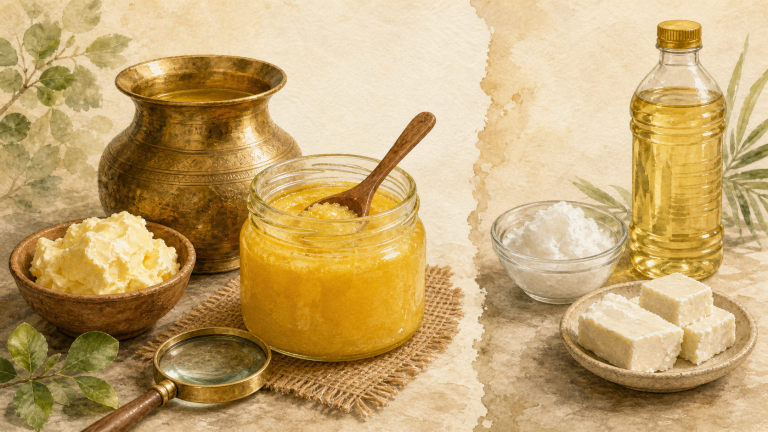
What Is A2 Ghee? Understanding Desi Cows, Bos indicus and the A2 Difference
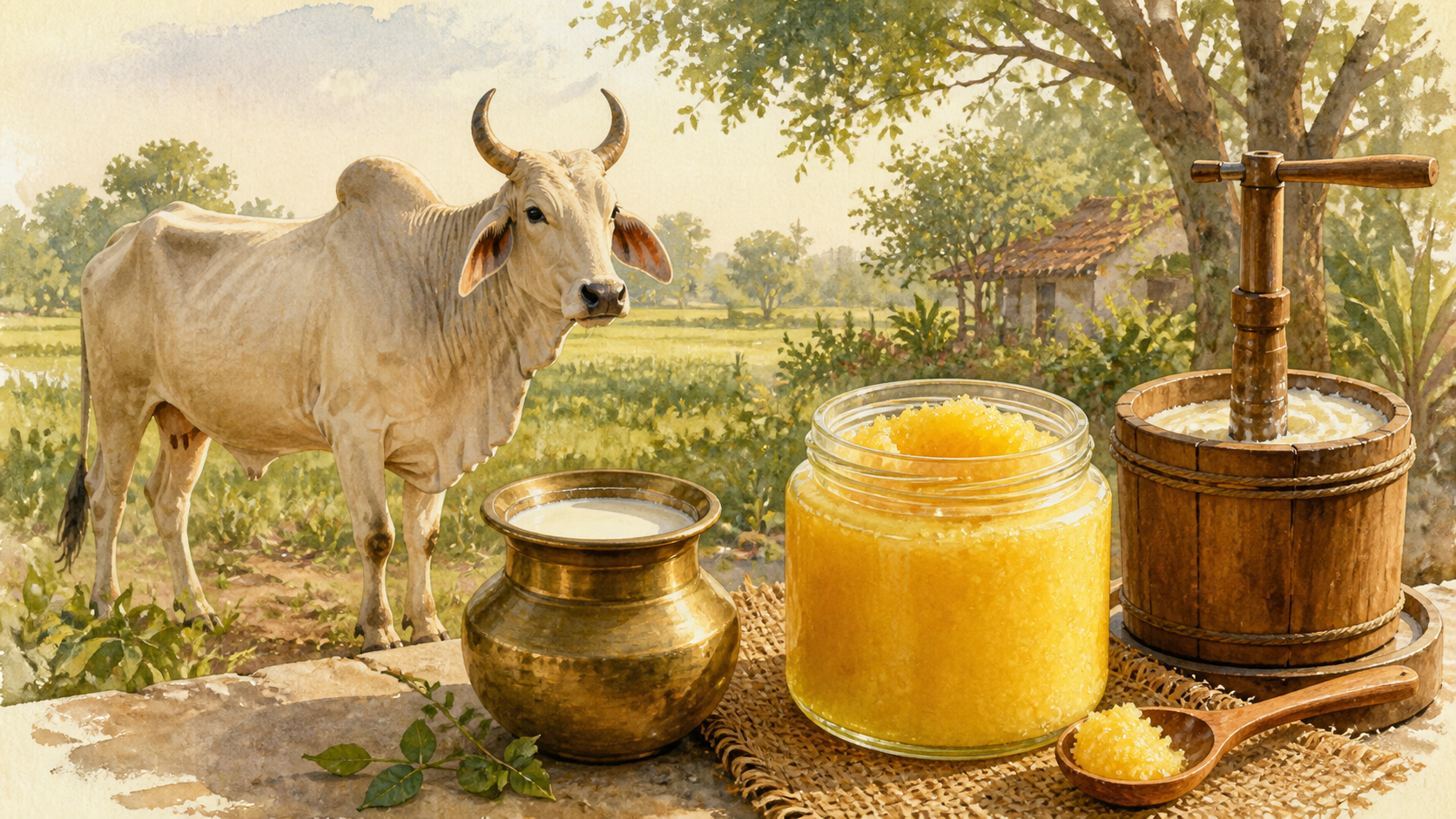
A2 ghee is ghee made from milk selected for the A2 form of beta-casein—most commonly associated in India with indigenous humped cattle, traditionally called Bos indicus or zebu/desi cows. Breeds such as Gir, Sahiwal, Kangeyam, Kankrej, Tharparkar and Red Sindhi have a high frequency of the A2 beta-casein gene. But the phrase “A2 ghee” is often misunderstood: A2 describes a milk protein, while ghee is almost entirely milk fat.
What does “A2” actually mean?
Cow’s milk contains several proteins. One of them is beta-casein, which occurs in genetic variants including A1 and A2. The two variants differ by a single amino acid at position 67 of the protein. A cow inherits two beta-casein gene copies and may therefore be A2A2, A1A2 or A1A1.
Milk marketed as A2 should come from animals tested or reliably managed to produce only the A2 beta-casein variant. The cow’s breed can make A2 status more likely, but appearance, hump or breed name alone is not a laboratory confirmation of an individual animal’s genotype.
What are Bos indicus or desi cows?
Bos indicus refers to the humped zebu cattle adapted over centuries to tropical and subtropical conditions. In modern classification they are also described as Bos taurus indicus (as against Bos taurus taurus). Common characteristics include a shoulder hump, loose skin and dewlap, heat tolerance and resilience under local climatic conditions.
India’s indigenous cattle are diverse rather than one uniform type. Some breeds are valued for milk, others for draught ability, and many for both. Research across native Indian cattle populations has found the A2 allele at very high frequency, supporting their importance in A2 milk production.
How is A2 ghee made?
The A2 designation concerns the source milk. After that, ghee can be made through different processes.
Traditional cultured-butter or bilona method
- A2 milk is boiled and cooled.
- A starter culture is added to set the milk into curd.
- The curd is churned—traditionally with a bilona or wooden churner—to separate cultured butter.
- The butter is washed if required and heated gently.
- Water evaporates, milk solids brown and settle, and the clear aromatic fat is filtered as ghee.
This method produces a distinctive cultured aroma and flavour. It is labour-intensive and yields less ghee per litre of milk, which helps explain its higher price.
Cream-butter method
Ghee can also be made by separating cream from A2 milk, converting the cream to butter and clarifying it. This is still A2-source ghee when the milk genuinely comes from an A2A2 herd, although it should not be marketed as bilona or cultured-curd ghee unless that process was actually used.
The important protein paradox
A1 and A2 are variants of beta-casein protein. During ghee making, water and most milk solids—including casein, whey proteins and lactose—are removed. Properly clarified ghee is overwhelmingly fat and contains only trace residual protein, if any. Therefore, the A1-versus-A2 digestive research conducted on fluid milk cannot simply be transferred to ghee.
In other words, A2 ghee can communicate the breed, milk source, herd management and production tradition, but claims that its A2 protein provides major benefits are biologically less direct because very little protein should remain in the final product.
Is A2 milk easier to digest?
Some controlled studies and a systematic review suggest that, among people who report discomfort after drinking ordinary milk, A2-only milk may produce fewer digestive symptoms than milk containing A1 beta-casein. The evidence is most supportive for digestive outcomes; evidence for broader claims involving diabetes, heart disease, autism, immunity or neurological health is low, very uncertain or insufficient.
What benefits can good-quality ghee offer?
- Concentrated flavour: a small quantity can add richness and aroma to dal, rice, millet dishes, rotis and traditional sweets.
- Cooking performance: removal of water and most milk solids gives ghee better heat tolerance than butter.
- Fat-soluble nutrients: ghee can contain vitamins such as A and E, although amounts vary with the animal’s feed, season and processing.
- Traditional food value: carefully sourced desi-cow ghee can support indigenous breeds, local dairying skills and traceable rural livelihoods.
- Low lactose: proper clarification removes nearly all lactose, so many lactose-intolerant people tolerate ghee better than milk. Individual responses vary.
What A2 ghee does not automatically guarantee
A2 is not the same as organic
A2 refers to beta-casein genetics. Organic refers to certified production practices, including feed, veterinary inputs, land management, processing, records and inspections. A2 ghee may be conventional or organic. Look for valid organic certification rather than assuming the words “A2” or “desi cow” prove it.
A2 is not automatically bilona
Bilona describes the method; A2 describes the source milk protein. A product can be A2 but made by the cream method, or bilona-made from milk whose beta-casein status was never verified.
Desi-cow imagery is not genetic proof
A picture of a humped cow, the colour of the ghee or a grainy texture cannot establish A2 status. Ask whether the herd is breed-identified and A2A2 tested, and whether the producer maintains traceable milk segregation.
It is still a concentrated fat
Ghee is calorie-dense and rich in saturated fat. A2 status does not change that. Use it as a flavourful cooking fat in sensible quantities within an overall varied diet, particularly if you are managing LDL cholesterol or cardiovascular risk.
Can people with dairy allergy eat A2 ghee?
A2 milk still contains cow’s-milk proteins; it is not hypoallergenic and is not a treatment for milk-protein allergy. Although well-made ghee contains very little residual protein, trace amounts may remain or contamination may occur during production. Anyone with a diagnosed cow’s-milk allergy should follow their allergist’s advice and should not assume that A2 ghee is safe. Lactose intolerance and milk-protein allergy are different conditions.
How to choose authentic A2 ghee
- Check the legal name and ingredients: it should be dairy ghee made from milk fat, butter or cream—not vegetable fat or a ghee-flavoured spread.
- Ask about the herd: look for the named indigenous breed and credible A2A2 testing or herd records.
- Understand the process: if “bilona” or “cultured” is claimed, the producer should explain that curd was churned into butter before clarification.
- Look for traceability: verify the manufacturer, FSSAI licence, batch number, dates, seal and customer-care information.
- Verify organic claims separately: check for recognised certification and certifier details.
- Be cautious of miracle claims: purity, animal welfare and good processing are meaningful; promises to cure disease are not.
Why indigenous breeds matter beyond A2
Reducing desi cows to one protein variant misses their larger value. Locally adapted cattle contribute genetic diversity, resilience to heat and regional conditions, manure for mixed farming, and livelihoods connected to local breeds. Supporting ethical, well-managed indigenous-cattle dairies can help conserve this diversity.
The quality of ghee also depends on factors not captured by “A2”: animal health and welfare, fodder quality, cleanliness, milk freshness, fermentation, clarification temperature, storage and freedom from adulteration.
The bottom line
A2 ghee is ghee made from milk sourced from cows producing the A2 beta-casein variant, often indigenous Bos indicus breeds. It can be an aromatic, traceable traditional fat and may support native cattle systems. But A2 is a milk-protein designation, and properly made ghee contains almost no milk protein. Choose it for credible sourcing, craftsmanship, flavour and farming values—not because of exaggerated medical promises.