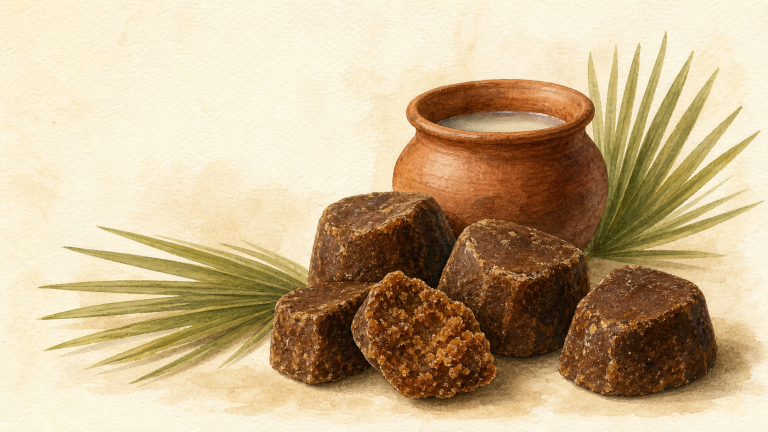
Karupatti vs Palm Crystal Sugar and Palm Candy: What Is the Difference?
Karupatti, palm crystal sugar and palm candy all begin with the sweet sap of a palm. Because they share the same origin, their names are often used as though they mean the same thing. They do not.
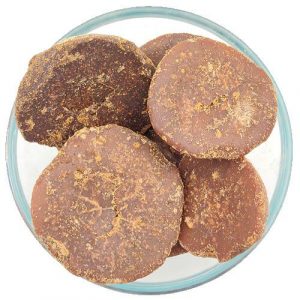
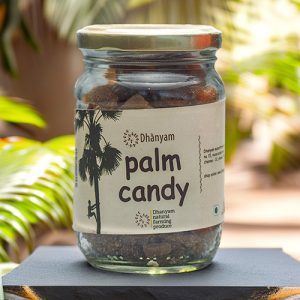
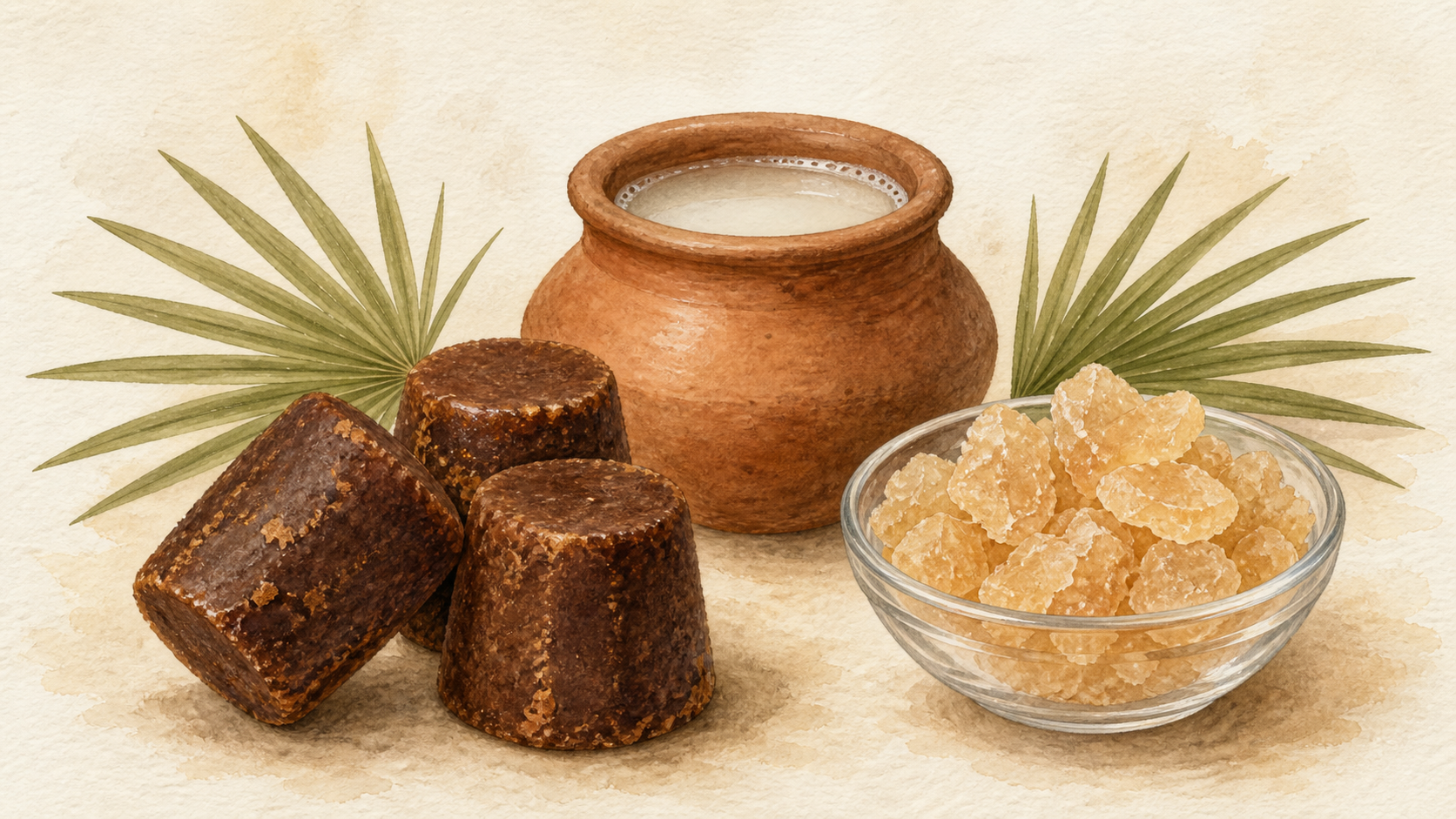
Karupatti is a dark, whole-sap jaggery made by concentrating palm sap and setting the thick mass in moulds. Palm candy—known in Tamil as panang kalkandu—is produced by taking clarified, concentrated palm syrup through a slower and more controlled crystallisation process. Palm crystal sugar may refer to those larger candy crystals, but some sellers use the term for smaller granulated palm sugar. Texture is therefore a better guide than the English name alone.
The short answer
| Feature | Karupatti / Palm Jaggery | Palm Crystal Sugar / Palm Candy |
|---|---|---|
| Starting material | Fresh, unfermented palm sap | Fresh, unfermented palm sap |
| Main process | Filtered, boiled down, thickened and moulded | Clarified and concentrated, then allowed to form distinct crystals |
| Appearance | Dark brown solid blocks or irregular lumps | Pale amber to brown translucent crystals |
| Texture | Dense, firm, sometimes crumbly or slightly moist | Hard, dry and crystalline |
| Flavour | Deep caramel, smoky, earthy and robust | Cleaner, lighter sweetness with mild caramel notes |
| Best suited to | Traditional sweets, porridges, payasam, sukku coffee and strongly flavoured dishes | Herbal drinks, milk, tea, delicate desserts and uses needing a neutral crystal |
The common beginning: fresh palm sap
In Tamil Nadu, these sweeteners are traditionally associated with the palmyra palm (Borassus flabellifer). A skilled tapper prepares the flower stalk and collects the dripping sap—called padaneer or neera—in a clean vessel. Coconut, date and other palms can also produce palm sweeteners, so the exact palm species should be stated on a trustworthy label.
Freshness matters immediately. Natural yeasts begin fermenting collected sap quickly, particularly in warm weather. Collection pots must be clean, and the interval between tapping and heating should be short. Traditional processors may prepare collection vessels to limit fermentation; practices vary by region and producer.
After collection, the sap is filtered to remove insects, fibres and other debris. From this point, heat, concentration and crystallisation control determine whether it becomes syrup, jaggery, granulated sugar or candy.
How karupatti is made
- Filtering: Fresh palm sap is strained into a clean boiling vessel.
- Clarifying: Foam and suspended material are removed as the sap warms. The exact traditional clarification method differs among producers.
- Open-pan boiling: Water evaporates and the sap becomes progressively darker, thicker and more aromatic.
- Endpoint judgement: The maker watches the bubbles, flow and consistency to decide when the concentrate will set properly.
- Moulding: The hot, thick mass is poured into coconut shells, cups or other moulds.
- Cooling: It sets into dense blocks that may range from medium to very dark brown.
The prolonged heating and concentration create karupatti’s robust flavour and dark colour. Heat changes the sugars and amino compounds in the sap, producing caramel-like and roasted notes. Differences in sap, season, clarification, heating and moisture explain why genuine batches do not all look or taste identical.
How palm candy is made
Palm candy begins similarly but requires more control after concentration:
- Clean sap collection and filtering: Fresh sap is collected before fermentation and carefully strained.
- Clarification and boiling: The sap is heated into a concentrated syrup. A cleaner syrup generally produces clearer crystals.
- Crystallisation preparation: The syrup is transferred at the correct concentration into crystallising vessels. Some methods use seed crystals or strings to give sucrose crystals a surface on which to grow.
- Slow crystal growth: Instead of being immediately moulded as a whole mass, the syrup is left under controlled conditions so individual crystals form and enlarge. Traditional large-crystal candy can take substantially longer than jaggery.
- Separation and drying: The crystals are removed from the remaining syrup or molasses, then drained and dried before packing.
This extra clarification and crystal-growth stage explains palm candy’s lighter colour, hard bite and cleaner sweetness. It also helps explain why authentic large palm-candy crystals can cost more: production ties up vessels, space and working capital while the crystals develop.
Where palm sugar granules fit
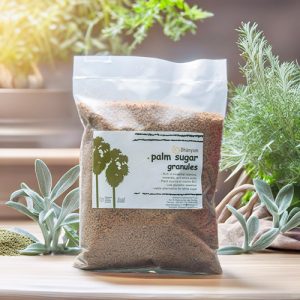
Granulated palm sugar is a third useful form. Concentrated syrup is encouraged to crystallise into much smaller particles, often through agitation and controlled cooling, and is then dried and sieved. It pours and measures easily, making it convenient for baking, beverages and everyday substitution.
Some packs call these fine granules “palm crystals,” while others reserve “palm crystal sugar” for large palm candy. When shopping, check the photograph, particle size and ingredient declaration rather than relying on the front-of-pack term.
How their flavours differ
Karupatti
Karupatti has the bolder personality. Expect dark caramel, smoke, malt, earth and sometimes a lightly mineral finish. Its flavour remains noticeable after cooking, which is why it works particularly well with ginger, dry ginger, sesame, coconut, millets and roasted ingredients.
Palm candy
Palm candy is usually milder and cleaner. It provides sweetness without dominating delicate herbs, milk or light desserts. The crystal dissolves more slowly when used whole; crushing it speeds dissolution.
Palm sugar granules
Granules fall between the two: more palm character than refined white sugar, but generally easier to measure and distribute than a jaggery block. Flavour intensity varies by palm species and the degree of heating.
Which one should you use?
Choose karupatti for:
- Sukku coffee and strongly spiced herbal drinks
- Ragi, millet and rice porridges
- Payasam, pongal, paniyaram and kozhukattai
- Sesame, peanut and coconut sweets
- Recipes where deep palm flavour is part of the identity
Choose palm candy for:
- Warm milk and mild herbal infusions
- Tea or coffee when a cleaner sweetness is preferred
- Delicate payasam and milk desserts
- Crushing into a topping for porridge or fruit
- Traditional preparations that specifically call for panang kalkandu
Choose palm sugar granules for:
- Baking where even distribution matters
- Quick-dissolving beverages
- Sprinkling over breakfast foods
- Recipes measured by spoon or cup
Can they be substituted for one another?
Often yes, but not perfectly. Begin with less than a one-for-one substitution and adjust after tasting. Karupatti brings more flavour, colour and moisture; it can darken a pale dessert and alter texture. Palm candy may need to be crushed or dissolved first. Granules are the easiest direct substitute where texture matters.
For baking, remember that a moist jaggery block behaves differently from dry crystals. Grate karupatti, check for hard particles, and consider slightly reducing other liquid in the recipe. For cold drinks, dissolve any form in warm water first and strain if necessary.
Are their health effects different?
All three are concentrated sweeteners. They may retain small quantities of minerals and flavour compounds from palm sap, with amounts varying by species and processing. Those differences do not turn them into supplements, medicines or unrestricted foods.
Karupatti, palm candy and palm sugar all contribute free sugars and calories. People managing diabetes, insulin resistance, dental problems, high triglycerides or weight concerns should count them as added sugar. “Natural,” “organic” and “traditional” do not mean sugar-free or suitable for unlimited use.
Choose between them primarily for authenticity, flavour, texture and culinary use—not because one is guaranteed to cure coughs, anaemia or digestive problems.
How to buy well
- Check the palm source: Look for palmyra, coconut or date palm rather than the vague word “palm.”
- Read the ingredients: A plain product should list palm sap sugar or palm jaggery without cane sugar, glucose syrup, colour or flavouring.
- Expect variation: Natural batches vary in shade and aroma. Extremely uniform colour is not proof of purity.
- Match appearance to the name: Karupatti should be a dense block or lump; palm candy should show distinct hard crystals; granulated palm sugar should pour freely.
- Look for traceability: Producer, origin, batch, packing date and credible organic certification are more useful than broad wellness claims.
- Avoid miracle marketing: Detox, diabetes-safe and instant-cure claims are warning signs.
Storage
Moisture is the main enemy. Store every form in a clean, dry, airtight container away from heat, steam and strong odours. Use a dry spoon. Karupatti may soften in humid weather; palm candy and granules may clump. Clumping alone is not necessarily spoilage, but discard products showing mould, insects, fermentation or an abnormal smell.
The Dhanyam takeaway
Karupatti and palm candy are not competing versions of the same product. They are two expressions of palm sap shaped by different finishing methods.
Choose karupatti when you want deep, earthy palm flavour and a whole-sap jaggery texture. Choose palm candy when you want a lighter taste, hard crystal and slow, clean sweetness. Choose palm sugar granules when convenience and easy measuring matter most. Whichever form you buy, prioritise a clearly named palm source, transparent processing and moderate use.
References
- FAO: Traditional palm-sap sugar products and processing
- FAO AGRIS: Process optimisation for palmyra palm jaggery
- Study of thermal processing and traditional palm-sugar quality
- Review of palm-sap sugar composition, processing and food uses
- Tamil Nadu Agricultural University: Palmyra and value-added palm products