Pesticide Residues in Fruits and Vegetables: Why Organic Matters

Fresh fruits and vegetables are essential to a healthy diet. But they are also living crops exposed to insects, fungi, weeds and weather from the field until harvest. Conventional farming often manages these pressures with insecticides, fungicides, herbicides and other crop-protection chemicals. When they are used correctly, the dose, timing and waiting period before harvest are designed to keep residues within legal limits. When they are overused, mixed indiscriminately, (as they are often done) applied too close to harvest or used on a crop for which they are not approved, residues can remain on the food we bring home.
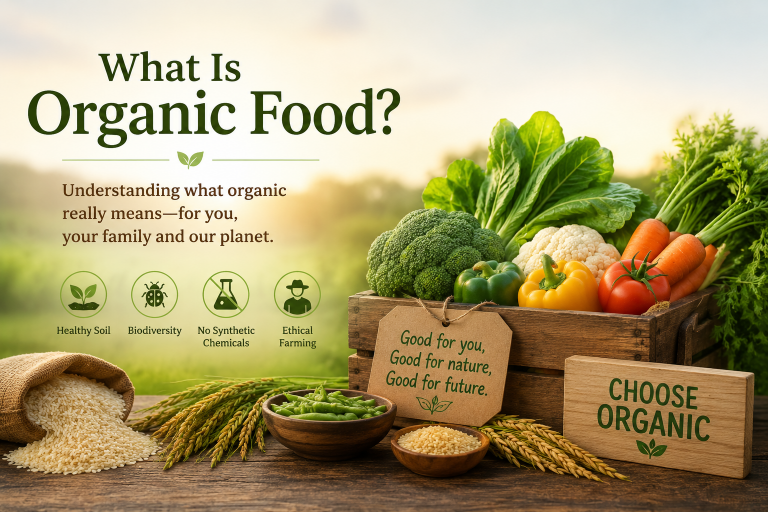
This is one of the clearest reasons to choose certified organic fruits and vegetables. Organic farming does not mean that plants are never protected from pests. It means that prohibited synthetic pesticides are excluded, permitted inputs are restricted, and farmers must rely much more on prevention, crop diversity, soil health, physical controls and biological pest management.
What is a pesticide residue?
A pesticide residue is the small amount of an active substance, its breakdown products or related compounds that remains in or on food after a pesticide has been used. Residue may be present on the surface, trapped in waxy leaves and folds, or absorbed into plant tissue.
Regulators establish a maximum residue limit (MRL) for a particular pesticide–crop combination. An MRL is not a declaration that every amount below it is nutritious or desirable; it is an enforcement limit derived from correct agricultural use and toxicological assessment. Safety assessments also consider acceptable daily intake over a lifetime and, where relevant, an acute reference dose for short-term exposure. One must be careful about these limits because even these may have been arrived at based on reports submitted by the pesticide industry.
What Indian monitoring has found
In a national monitoring report published by FSSAI, 6,670 vegetable samples from retail outlets and APMC markets were analysed.
Brinjal showed the largest number of detections in that dataset, followed by tomato, okra, cabbage, cauliflower and cucumber. Commonly detected compounds included acephate, chlorpyrifos, imidacloprid, carbendazim, acetamiprid, profenofos, methamidophos and thiamethoxam.
These figures are a snapshot of a monitoring period, not a prediction about every vegetable in every market today. They make an important point – residue misuse and above-limit results were real enough to justify continued monitoring and a more traceable food system.
Kinds of pesticides used on fruits and vegetables
“Pesticide” is an umbrella term. Different products are used for different problems:
- Insecticides target caterpillars, borers, aphids, thrips, whiteflies, beetles and other insects.
- Fungicides manage blights, mildews, rots, leaf spots and moulds.
- Herbicides suppress weeds competing with the crop.
- Acaricides control mites.
- Nematicides target plant-parasitic nematodes in soil.
- Rodenticides and storage pesticides may be used around storage facilities to protect produce and premises.
Chemical families encountered in vegetable production can include organophosphates, synthetic pyrethroids, neonicotinoids, diamides, spinosyns, carbamates and various protective or systemic fungicides. Approval status changes over time and differs by crop. A chemical being registered somewhere does not permit its use on every vegetable.
Which crops tend to face which pressures?
Tomato, brinjal, chilli and okra
Fruit and shoot borers, whiteflies, thrips, mites and sucking pests can cause visible damage and transmit disease. Farmers may use insecticides against these pests and fungicides against blights, wilts, anthracnose and fruit rots. Because consumers reject even small insect holes or blemishes, cosmetic market standards can encourage repeated spraying.
Leafy vegetables
Spinach, amaranth, coriander leaves, mint and other greens have a large exposed surface and are often harvested repeatedly at short intervals. Aphids, leaf miners, caterpillars and fungal leaf spots may be treated. A short gap between spraying and harvest is especially concerning because there is less time for residues to decline.
Beans, gourds and cucumbers
Fruit flies, pod borers, beetles, aphids, whiteflies, mildews and viruses are common pressures. Insecticides, fungicides and miticides may be used according to the crop and pest. Tender produce is harvested frequently, making careful adherence to the pre-harvest interval essential.
Potato, onion and root vegetables
Soil pests, foliage-feeding insects, blights and storage rots can lead to field treatments and, for some crops, tightly regulated post-harvest or storage measures. Peeling may remove some surface residue, but systemic residues and contaminants taken up from soil cannot simply be washed away.
Grapes, apples, mangoes and other fruits
Fruit crops may receive insecticides for borers, flies, scales and sucking pests, as well as fungicides for mildew, scab, anthracnose and rots. Some fruits have long seasons and many treatment opportunities. Residue control depends on using only authorised products, respecting dose and waiting periods, and maintaining records across the season.
Why cabbage, cauliflower and broccoli deserve special attention
Cabbage, cauliflower and broccoli belong to the brassica or cole-crop family. Their tightly folded leaves, developing heads and flower structures create protected hiding places for pests. Major enemies include:
- diamondback moth;
- cabbage butterfly and other caterpillars;
- aphids;
- tobacco caterpillar or Spodoptera;
- stem borers;
- downy mildew, Alternaria leaf spot, damping-off and rots.
These pests directly damage the marketable part. A caterpillar inside a cauliflower curd or holes in a cabbage head can make an otherwise nutritious crop commercially unacceptable. This creates strong pressure to spray frequently.
An ICAR–Indian Institute of Horticultural Research field demonstration documented conventional cauliflower practice in which combinations of synthetic insecticides were sprayed every three to four days, reaching roughly 18–20 applications over the crop. The chemicals reported from that local practice included products such as diafenthiuron, dichlorvos, lambda-cyhalothrin, indoxacarb, flubendiamide and spinosad. This illustrates how intense pest pressure can translate into repeated chemical intervention.
Why the shape of these vegetables matters
Cabbage has overlapping leaves; cauliflower has a dense, uneven curd often enclosed by wrapper leaves; broccoli has hundreds of tightly packed buds. Spray droplets, soil and insects can lodge in crevices. Removing outer leaves and washing helps, but these structures are harder to clean thoroughly than a smooth-skinned fruit.
Cleaning, packing and transportation
Applying insecticide or fungicide casually to harvested cabbage, cauliflower or broccoli to suppress insects, delay visible decay or “freshen” produce is a common practice among farmers and may result in high pesticide residue.
What can pesticide exposure do to health?
Pesticides are designed to affect living organisms. Their effects on people depend on the specific compound, dose, route and duration of exposure.
Acute exposure
A large exposure can cause nausea, vomiting, sweating, headache, dizziness, breathing difficulty, confusion, muscle weakness, seizures or other symptoms. Farm workers, pesticide applicators and people near spraying generally face much greater acute risk than consumers eating food with low residues. Suspected pesticide poisoning is a medical emergency.
Long-term concerns
Depending on the compound and exposure, toxicological assessments examine possible effects on the nervous, endocrine, reproductive, immune, liver and kidney systems, development and cancer risk. It is unwise to treat preventable exposure as irrelevant, particularly when non-approved chemicals or residues above limits are found.
Why children warrant care
Children eat and drink more relative to their body weight, their organs and nervous systems are developing, and they have a longer lifetime ahead for cumulative exposures to matter. Pregnancy is also a sensitive period. This supports a precautionary effort to reduce unnecessary pesticide exposure while maintaining a varied, produce-rich diet.
Why buying organic makes sense
Certified organic standards prohibit most synthetic pesticides and require documented cultivation and handling systems. Farmers build protection through crop rotation, resistant varieties, healthy soil, trap crops, nets, pheromone traps, hand removal, neem-based inputs, microbial agents and natural predators.
Research consistently finds fewer detectable synthetic pesticide residues in organic crops, and dietary intervention studies show that switching to organic food can lower measured pesticide metabolites in urine. This demonstrates reduced exposure.
Organic is therefore a sensible precaution and a vote for a farming system that asks first how pests can be prevented ecologically.
Organic alternatives for brassica pests
Cole crops can be grown with much lower reliance on synthetic insecticides through integrated methods:
- mustard as a trap crop;
- insect netting and careful nursery hygiene;
- pheromone traps and regular field scouting;
- manual removal of egg masses and caterpillars;
- neem formulations used according to organic standards;
- protection of parasitoid wasps, ladybirds and other beneficial insects;
- crop rotation, balanced nutrition and removal of infected crop debris.
ICAR-IIHR has demonstrated a neem-seed-powder pellet approach for cabbage and cauliflower that reduced chemical dependence while managing diamondback moth and aphids. Organic farming is not “doing nothing”; it substitutes knowledge, observation and biological management for routine calendar spraying.
Does washing remove pesticide residues?
Washing is always worthwhile. It can reduce dirt, microbes and some pesticide residues, especially material remaining on the surface. It cannot guarantee removal of every residue, particularly systemic pesticides absorbed into plant tissue or compounds held in waxy surfaces and tight crevices.
The Dhanyam approach
For Dhanyam, “organic” must be more than a sticker attached at the end of the supply chain. Sustained work with farms and producer groups helps establish how a crop was grown, what inputs were used, when it was harvested and how it travelled to the store.
Organic vegetables may occasionally show a small insect hole or natural variation. Those are not signs of failure. Food does not need cosmetic perfection to be fresh, nutritious and worthy of the table. A more realistic standard is traceability, honest cultivation, safe handling and good flavour.
Shop organic vegetables
Availability changes with genuine farm harvests and seasons. Explore Dhanyam’s organic cabbage and cauliflower when they are in stock, along with the wider fruits and vegetables range.

The bottom line
Pesticides can protect crops and yields, but poor selection, excessive spraying, off-label use and failure to observe the pre-harvest interval can leave high residues. Cabbage, cauliflower and broccoli deserve particular attention because serious insect pressure can lead to frequent sprays and their folded, tightly packed structures are difficult to clean completely.
Certified organic produce is a practical way to reduce exposure to synthetic pesticide residues and support farming based on prevention, biodiversity and biological controls. Wash all produce, including organic produce, but remember that the most effective residue reduction begins in the field—not at the kitchen sink.
Further reading
- World Health Organization: pesticide residues in food
- FSSAI: monitoring of pesticide residues at national level
- ICAR-IIHR: eco-friendly management of cabbage and cauliflower pests
- APEDA: organic crop-production standards and permitted inputs
- Systematic review of organic versus conventional food consumption
- Meta-analysis of pesticide-residue incidence in organic and conventional crops