Dhanyam Raw Honey: From Forest to Bottle
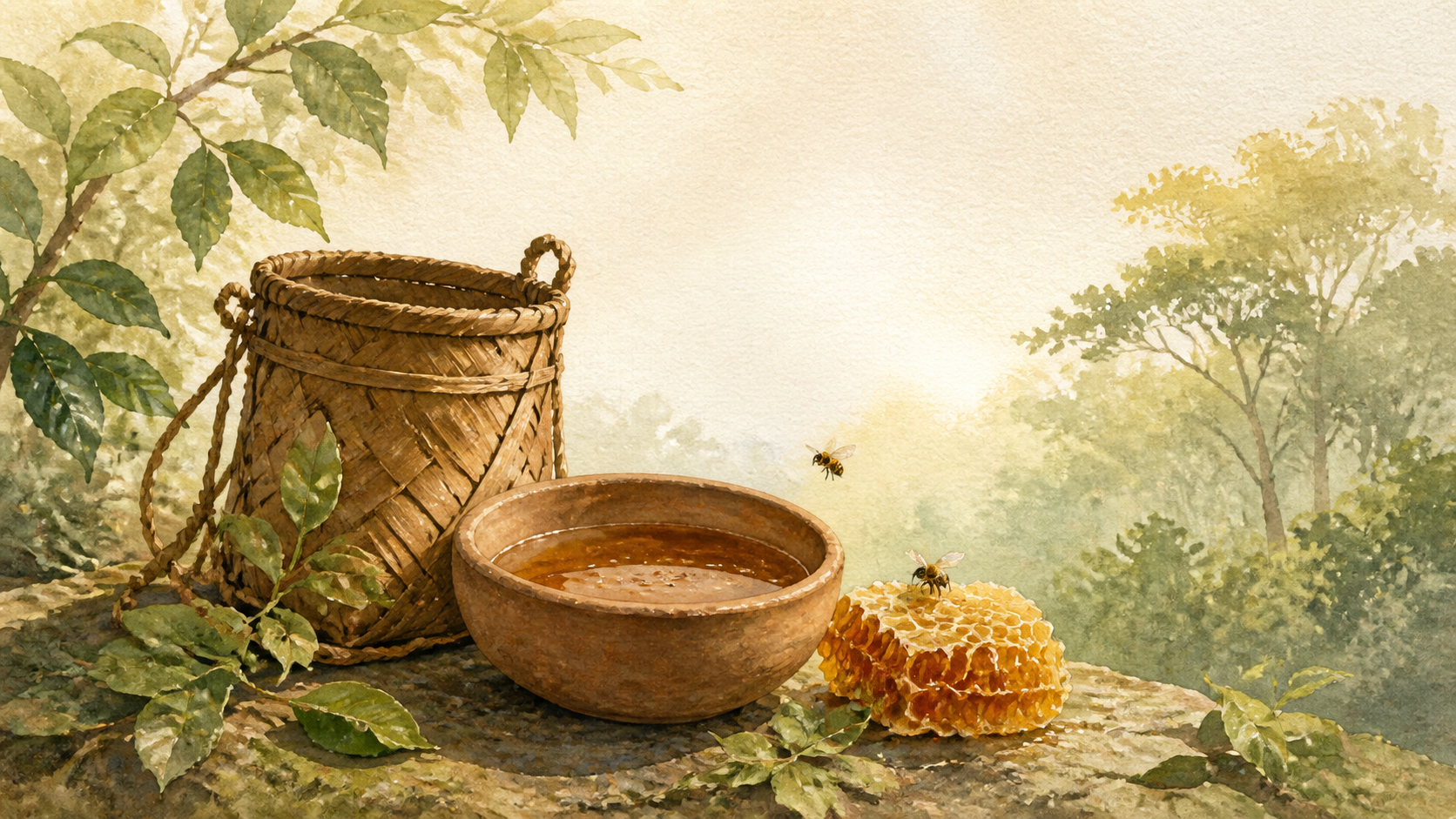
Honey can look like a very simple food: bees gather nectar, transform it, and store it in comb. Yet the journey from comb to bottle can vary enormously. The origin of the nectar, the way the bees are managed, the maturity of the honey at harvest, exposure to heat, filtration, storage and the possibility of added syrup all influence what finally reaches the kitchen.
Dhanyam Raw Honey is pure forest-collected honey gathered by tribal communities. After collection, it is filtered to remove visible pieces of wax and forest matter, mildly sun-dried to reduce excess moisture, and packed. It is not made uniform through intensive heating or industrial processing. Natural differences in colour, aroma, thickness and crystallisation are therefore part of its character.
From the forest to the bottle
Wild and semi-wild forest bees forage across the flowers available in their landscape. Unlike a honey designed around one cultivated crop, forest honey may carry the character of many trees, shrubs, herbs and seasonal blossoms. Rainfall, altitude, flowering cycles and the bee species can all alter its taste from one harvest to the next.
Tribal honey collectors bring detailed local knowledge: where colonies occur, when the comb is mature and how the surrounding forest changes through the year. Responsible collection must also respect the colony and its food reserves. Forest honey is not simply an ingredient extracted from a landscape; it depends on the continuing health of that landscape and on the skill and livelihood of its custodians.
At Dhanyam, the handling is deliberately minimal:
- Collection: mature forest honey is gathered by experienced tribal communities.
- Filtering: the honey is filtered to remove visible wax, comb fragments and other physical matter.
- Gentle moisture reduction: it is mildly sun-dried when needed, rather than aggressively boiled, so excess moisture is reduced.
- Packing: the honey is packed without trying to erase its natural seasonal character.
Raw honey and processed honey: what is the difference?
“Raw” generally describes honey kept close to its condition in the comb: strained or filtered, but not subjected to substantial heat treatment or intensive fine filtration. There is no single worldwide definition used identically by every seller, so the process behind the word matters.
Commercially processed honey may be warmed to make pumping and bottling easier, finely filtered for clarity, blended across harvests for a consistent taste, or pasteurised to delay fermentation and slow crystallisation. These operations can give a bright, uniform liquid with a long shelf appearance. Stronger heating, however, can reduce heat-sensitive enzyme activity and alter aroma. FSSAI standards accordingly state that honey should not be heated or processed so extensively that its essential composition changes or its quality is impaired.
Raw honey is not “sugar-free” or a miracle food. It remains predominantly natural sugars and should be used in modest quantities. Its value lies in minimal handling, distinctive flavour and a closer connection to origin—not permission for unlimited consumption.
Crystallisation is natural
Real honey can crystallise. The speed depends on its glucose-to-fructose ratio, pollen and fine particles, temperature and storage. Some honeys crystallise quickly; others remain liquid for a long time. Crystallisation is neither proof of adulteration nor, by itself, proof of purity.
If you prefer liquid honey, stand the closed bottle in comfortably warm water and allow it to loosen gradually. Avoid boiling it or placing it over direct heat. A change in thickness with season is normal.
Forest honey and apiary honey: not the same distinction as raw and processed
These terms answer different questions:
- Forest versus apiary describes where the bees live and forage and how colonies are managed.
- Raw versus processed describes what happens to the honey after harvest.
An apiary is a managed collection of beehives. Apiary honey can be excellent, traceable and minimally heated when beekeepers follow good practice. It can also be raw. Forest honey, meanwhile, can lose much of its character if it is overheated or poorly stored after collection. “Forest” is therefore not an automatic certificate of quality, just as “apiary” is not a synonym for inferior honey.
Forest honey’s special appeal comes from its diverse forage, seasonal expression, minimal management of the bees and relationship with forest communities. Good apiary honey offers a different strength: close hive management and, in some cases, clear identification of the main floral source. The decisive questions are always who produced it, how the bees and honey were handled, and whether the supply chain can be traced.
What can go wrong in a poorly controlled commercial supply chain?
Sugar syrup and adulteration
Honey may be directly adulterated after harvest with cheaper cane, corn, rice, beet or other syrups. This is food fraud. FSSAI has strengthened honey standards and analytical methods but still sophisticated syrups can be difficult to detect.
Supplemental feeding is a separate issue. Beekeepers sometimes provide sugar solution when natural forage is scarce to prevent colonies from starving. If colonies are fed syrup while marketable honey is being produced, or if resulting stores are harvested and represented as floral honey, authenticity and quality become concerns.
Veterinary medicine and antibiotic residues
Managed colonies can suffer bacterial and other diseases. So veterinary medicine prescribes antibiotics which are typically fed via sugar solutions to the bees. This can leave residues in honey and can contribute to antimicrobial resistance.
Excessive heat and loss of identity
Heating can make bottling quicker and keep honey visibly liquid. Gentle, controlled warming is different from prolonged overheating. Excessive heat can flatten volatile floral aromas, reduce enzyme activity and increase heat-related quality markers. Blending many origins can further produce a standardised sweetness with little sense of place.
Ayurveda and the traditional caution against heating honey
Ayurvedic tradition commonly advises that honey should not be cooked or heated strongly. Infact many Ayurvedic practitioners claim that honey becomes poison on heating. This guidance belongs to Ayurveda’s own framework of food qualities and preparation. Modern food chemistry approaches the question differently, but it also shows a practical reason to avoid unnecessary high heat: heat-sensitive enzymes and delicate aromas decline as heat exposure increases.
Dhanyam’s approach is therefore to keep processing gentle. Mild sun drying is used only to lower excess moisture where needed; the honey is not boiled or industrially pasteurised to make every batch look identical.
For home use, add honey after a drink or dish has cooled to warm rather than stirring it into boiling liquid. This respects traditional practice and better preserves flavour.
How to use raw honey
As food
- Drizzle a small amount over fruit, porridge, curd or unsweetened muesli.
- Stir it into warm—not boiling—water or herbal infusions.
- Use it in dressings with lime, vinegar, ginger or mustard.
- Pair it with nuts, millet pancakes or whole-grain toast.
- Use its forest aroma deliberately; a little may provide more flavour than a neutral sweetener.
For cough and throat comfort
Honey has a long traditional use for soothing the throat, and clinical reviews suggest it may help reduce acute cough symptoms in children over one year and adults. It is supportive food care, not a cure for infection or a substitute for medical assessment. Persistent cough, breathing difficulty, high fever, dehydration or symptoms in a medically vulnerable person require professional advice.
Important safety notes
- Never give honey to a baby under 12 months. Honey can contain Clostridium botulinum spores that an infant’s immature intestine cannot safely handle.
- Honey is concentrated sugar. People with diabetes or those managing blood glucose should count it as a sweetener and follow individual medical advice.
- Anyone with allergy to honey, pollen or bee products should be cautious and seek advice if they have reacted before.
- Keep the lid closed, use a clean dry spoon and protect the bottle from excess heat and moisture.
Why laboratory tricks at home cannot prove purity
Videos often claim that pure honey will not dissolve in water, will burn on a wick, will not soak into paper, or will form a particular thread. These tests are unreliable. Moisture, botanical source, temperature, crystallisation and storage can change how genuine honey behaves. Modern syrup adulteration may require validated laboratory techniques.
Certification and testing are useful, but a report is still only a snapshot of a particular sample. For a living, seasonal food, authenticity also depends on knowing the collection community, understanding the landscape, observing handling and maintaining records over time.
The Dhanyam approach: authenticity is a relationship
There is no single kitchen test that can tell the complete story of a bottle of honey. For Dhanyam, the strongest assurance comes from working with the source on a sustained basis—not buying anonymous honey from whichever trader offers the lowest price that season.
Long-term relationships with tribal collection communities build practical knowledge: how the harvest changes, what a normal batch looks and tastes like, how moisture is managed, and whether collection and handling remain consistent. That continuity also gives producers a reason to protect quality and gives Dhanyam the ability to question unexpected changes.
Traceability does not mean pretending nature is uniform. Quite the opposite: authentic forest honey may be lighter or darker, floral or woody, thin in warm weather, thick or crystallised in cooler conditions. Trust comes from being able to explain those differences and stand behind the path from forest to bottle.
Shop Dhanyam forest honey
Explore Dhanyam’s minimally handled forest-collected honeys. Product availability can change with genuine seasonal collection.
-
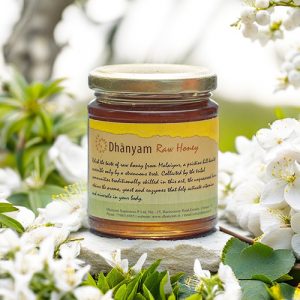
Organic Raw Honey | Forest Collected Wild Honey
Price range: ₹260.00 through ₹1,150.001250 g / 250 g / 500 g Add This product has multiple variants. The options may be chosen on the product page -
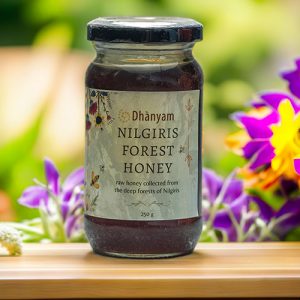
Organic Nilgiris Forest Honey
₹350.00250 g Add -
Rock Honey
₹850.00250 g Add
The bottom line
Dhanyam Raw Honey is forest-collected by tribal communities, filtered, mildly sun-dried to remove excess moisture and packed with minimal intervention. Its value is not that “raw” is a magical health label. It is the combination of forest origin, restrained handling, natural flavour and a supply relationship that can be followed over time.
Choose honey for traceable origin and honest processing. Enjoy it in small quantities, keep it away from unnecessary high heat, expect seasonal variation, and remember the non-negotiable rule: no honey for infants under one year.