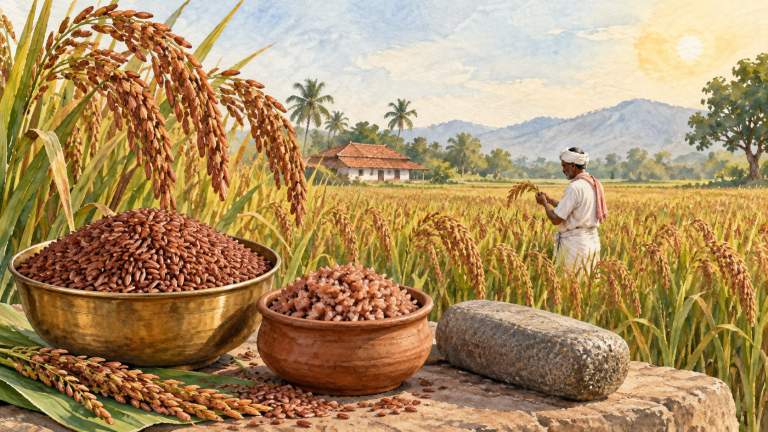
Food Choices for Diabetes: A Practical Dhanyam Guide
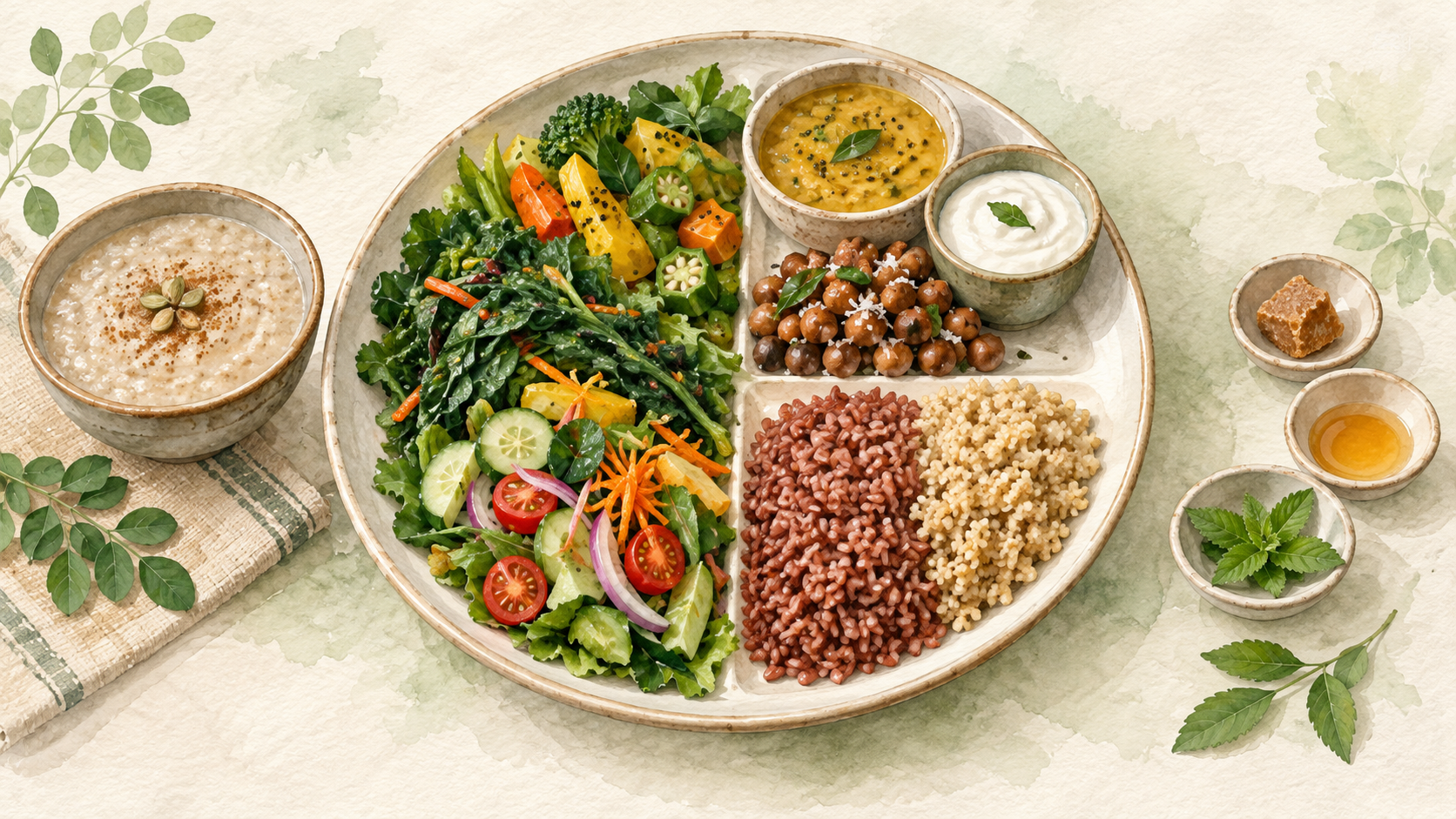
Living with diabetes does not require a separate cuisine or the abandonment of rice, millets and familiar South Indian meals. The more useful change is to rethink the whole plate: choose less-refined carbohydrate foods, keep their portions appropriate, add plenty of non-starchy vegetables, include a meaningful protein source and minimise added sugar.
Dhanyam offers many foods that can fit this approach—unpolished millets, traditional rice varieties, porridge mixes, fresh organic greens and natural sweeteners. But no grain, mix or sweetener is automatically “safe” in unlimited quantities. Blood-glucose response depends on the food, processing, cooking method, portion, accompanying foods, medication, activity and the individual person.
Begin with the diabetes plate
A simple starting point is the plate method recommended by diabetes organisations:
- Half the plate: non-starchy vegetables, especially greens, gourds, beans, cabbage, cauliflower, brinjal, okra, cucumber and salad vegetables.
- One quarter: protein—dal, sundal, sprouts, tofu, curd, egg, fish or another suitable choice.
- One quarter: carbohydrate food—millet, traditional rice, chapathi, porridge or another grain.
This is more valuable than merely replacing white rice with a “healthy” grain while continuing to fill most of the plate with it. Carbohydrates raise blood glucose; protein, fat and fibre eaten with them can slow the rise, but they do not make the carbohydrate disappear.
1. Millets: useful variety, not a free food
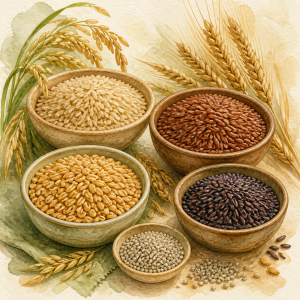
Thinai, samai, varagu, kuthiraivali, kambu and ragi can add fibre, texture and dietary diversity. Unpolished or minimally processed versions retain more of the grain’s outer layers than highly polished products. Also, they are low glycemic index foods and go a long way in streamlining blood glucose spikes after food. Therefore, millets can replace part of a refined-grain serving, but nevertheless they belong in the carbohydrate quarter of the plate.
Good Dhanyam options
- Thinai (foxtail millet): cooks as a grain and works in vegetable upma, pongal or a mixed-grain bowl.
- Unpolished samai (little millet): mild and versatile for savoury meals.
- Unpolished varagu (kodo millet): a firm grain that pairs well with dal and vegetables.
- Unpolished kuthiraivali (barnyard millet): suitable for savoury pongal, lemon-millet or curd-millet preparations.
- Kambu (pearl millet): traditionally used for koozh, kali and dosai.
- Ragi (finger millet): useful as a whole grain or flour, but porridge texture and sweetening matter.
-
Thinai | Foxtail Millet | Kangni
Price range: ₹95.00 through ₹170.001 kg / 500 g Add This product has multiple variants. The options may be chosen on the product page -
Samai Unpolished | Little Millet Unpolished
₹175.001 kg Add -
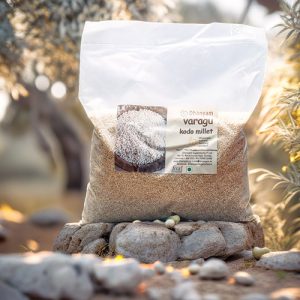
Varagu Unpolished | Kodo Millet Unpolished | Kutki Unpolished
₹175.001 kg Add -
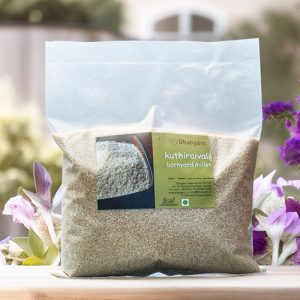
Kuthiraivali Unpolished | Barnyard Millet Unpolished
₹210.001 kg Add
How to use millets more effectively
- Begin with a modest cooked portion rather than a large mound.
- Cook it with vegetables and a pulse, or serve it with sambar, kootu, sundal, curd, egg or another protein.
- Avoid turning millet into a highly refined flour food with little vegetable or protein.
- If you monitor blood glucose, compare your response to the same measured portion on more than one occasion.
Example plate: one quarter vegetable samai upma, one quarter sundal or curd, and half a plate of sautéed greens, beans and other non-starchy vegetables.
2. Traditional rice: retain the bran and reduce the portion
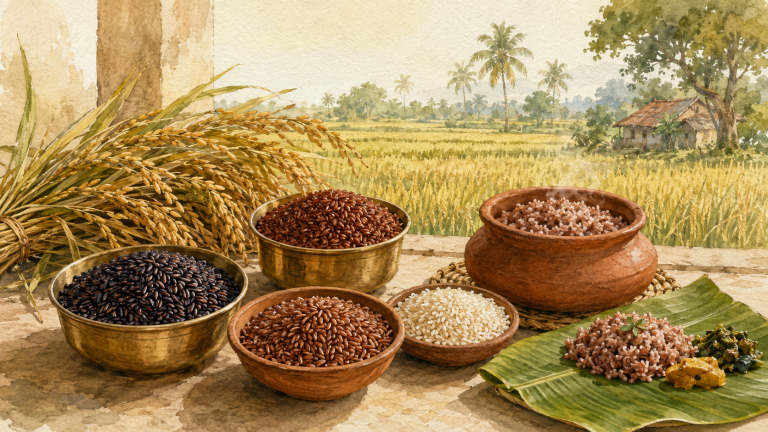
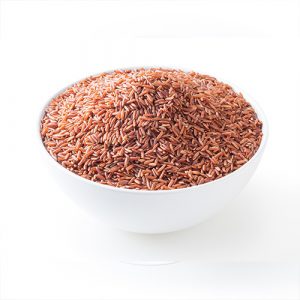
Mappillai Samba, Kullakar, Poongar and Karunkuruvai provide flavour, chew and agricultural diversity. Red and brown varieties retain pigmented bran when they are unpolished or minimally polished. That can mean more fibre and plant compounds than highly polished white rice.
Traditional rice is nevertheless rice. Its heritage name, red colour or firm texture does not automatically make it low-glycaemic or suitable in unrestricted quantities. The useful strategy is to choose the less-polished form, cook it to a pleasant but not mushy texture, keep it to roughly one quarter of the plate and eat it with vegetables and protein.
Dhanyam traditional-rice choices
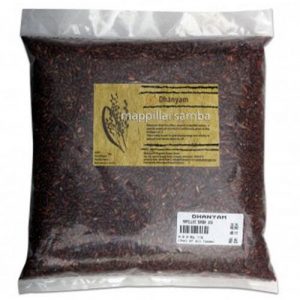
- Unpolished boiled Mappillai Samba: robust red rice with a pronounced chew.
- Kullakar boiled rice: a traditional Tamil variety suited to everyday meals.
- Poongar boiled rice: a heritage variety with its own aroma and texture.
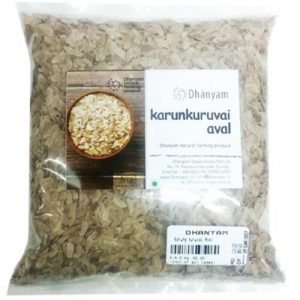
- Karunkuruvai boiled rice: a darker traditional rice that brings variety to the grain rotation.
Ways to make a rice meal more balanced
- Serve one smaller ladle of rice rather than making rice the base of the entire plate.
- Double the quantity of poriyal, keerai or other non-starchy vegetables.
- Add sambar with adequate dal, kootu, sundal, curd, egg, fish or another protein.
- Avoid automatically taking a second rice serving; pause and assess hunger first.
- Use rasam for flavour, not as a reason to consume a very large rice portion.
Someone using insulin or medicines that can cause hypoglycaemia should not drastically remove carbohydrates without professional guidance. Consistency and an individual plan are important.
3. Porridge mixes: read the ingredients and build a complete bowl
Organic Diabetic Friendly Porridge Mix
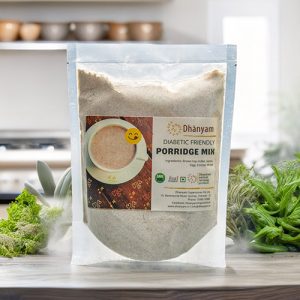
Dhanyam’s mix contains brown-top millet, samai, ragi and emmer wheat. These are useful whole-food ingredients, but the mix still supplies carbohydrate. Treat “diabetic friendly” as a description of the formulation, not permission for an unlimited bowl or a replacement for prescribed treatment.
Gluten-Free Kanji Mavu
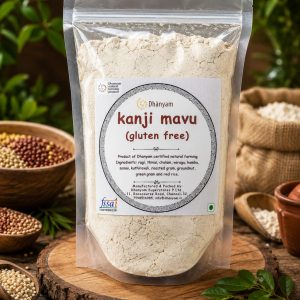
This mix combines several millets with roasted gram, groundnut, green gram and red rice. The pulses and groundnut make it more varied than a cereal-only powder. It can be used as a savoury porridge with minimally sweetened.
Sprouted Ragi Porridge Mix
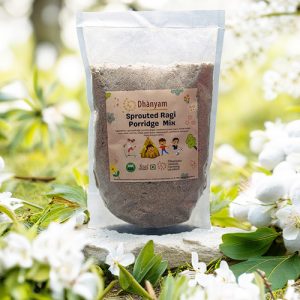
This is a diverse blend containing sprouted ragi, other millets and grains, pulses, coconut, groundnut and cashew. It was developed principally as a children’s porridge. Adults with diabetes can still use it, but should choose a measured portion and account for its grains and nuts within the meal.
A better savoury porridge formula
- Measure the dry mix rather than pouring by eye.
- Cook it thoroughly in water wherever possible without sweetners.
- Try non-sweetened but salted versions sometimes, by adding finely chopped greens, vegetables, pepper, cumin and curry leaves.
- Pair it with plain curdor a small pulse preparation where appropriate.
- Check the product ingredients for wheat, groundnut, cashew or other allergens.
If you prefer a sweet taste, use modest whole fruit where it fits your plan, or a very small amount of stevia after checking the product label.
4. Healthy greens: make these the generous part of the meal
Leafy greens are naturally low in carbohydrate and bring fibre, folate and a range of micronutrients. They are among the easiest foods to expand on a diabetes-friendly plate.
Dhanyam’s fresh selection changes with harvest and availability. Murungai keerai, palak, mulai keerai and agathi keerai can be rotated instead of relying on one leaf every day.
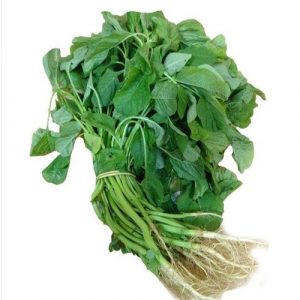
Practical ways to eat more greens
- Keerai poriyal: cook briefly with onion, garlic and a modest coconut garnish.
- Keerai kootu: combine greens with measured dal for fibre and protein.
- Murungai-keerai adai: add chopped leaves to a pulse-rich adai batter.
- Greens in porridge: stir chopped palak or mulai keerai into a savoury millet kanji.
- Soup or rasam: use greens to add body, but avoid straining away all the fibre.
Cooking greens with excessive salt, coconut milk or oil can change the overall meal. The objective is not to make greens medicinal; it is to make them a normal, generous part of lunch and dinner.
5. Natural sweeteners: “natural” does not mean blood-sugar free
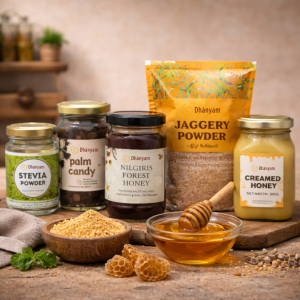
This is the most important distinction in the sweetener aisle. Karupatti, jaggery, palm candy and honey may differ in flavour, origin and processing, but they still contain sugars and can raise blood glucose. Trace minerals do not cancel the sugar load. Replacing one spoon of white sugar with several spoons of jaggery is not an improvement for glucose control.
Stevia
Stevia can provide sweetness with little or no available carbohydrate when the product contains stevia rather than being bulked mainly with sugar. Because formulations vary, read the ingredient list and serving instructions. It can help reduce added sugar, but it should not be used to make every food intensely sweet.
Karupatti, palm candy and raw honey
These are traditional foods with distinctive taste and culinary value. If included, use a genuinely small, measured amount and count it as added sugar. Raw honey is not a diabetes remedy, and karupatti is not a low-sugar food. People whose glucose is above target may be advised to avoid added sweeteners altogether.
-
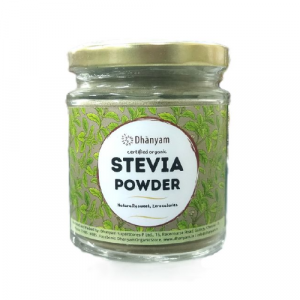
Dhanyam Stevia Powder
₹265.00100 g Add -
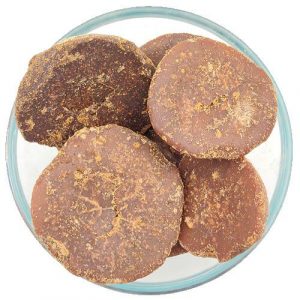
Organic Karupatti
₹475.00500 g Add -
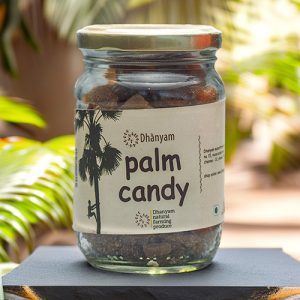
Organic Palm Candy
Price range: ₹260.00 through ₹625.00200 g / 500 g Add This product has multiple variants. The options may be chosen on the product page -
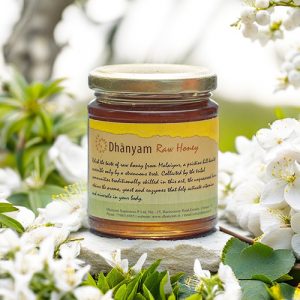
Organic Raw Honey | Forest Collected Wild Honey
Price range: ₹260.00 through ₹1,150.001250 g / 250 g / 500 g Add This product has multiple variants. The options may be chosen on the product page
Questions to ask before adding sweetness
- Can fruit, cardamom, cinnamon, coconut or roasted nuts provide enough flavour?
- Am I measuring the sweetener or pouring by eye?
- Is this occasional, or has sweetness entered every tea, porridge and snack?
- Does the product contain other sugars or starch-based fillers?
- What does my individual glucose monitoring show after this food?
A one-day South Indian meal example
This is an illustration, not a prescription. Portions must be individualised.
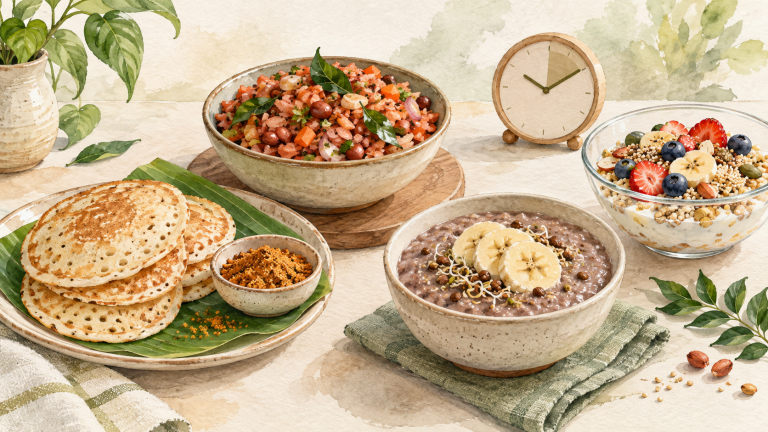
- Breakfast: a modest bowl of savoury millet porridge with chopped greens, plus plain curd.
- Mid-morning: one portion of whole fruit rather than juice.
- Lunch: half a plate of vegetables and keerai, one quarter protein from kootu or another suitable food, and one quarter unpolished traditional rice.
- Evening: unsweetened tea with a small handful of nuts, or vegetable sundal if it fits the meal plan.
- Dinner: vegetable-rich millet adai with curd, or a smaller traditional-rice serving with vegetables and dal.
How to learn from your own glucose response
Two people can respond differently to the same grain. Even the same person may respond differently depending on sleep, stress, activity, illness, medication and portion size.
- Test one change at a time—for example, replacing polished rice with a measured amount of unpolished Mappillai Samba.
- Keep the rest of the meal reasonably similar.
- Record the portion, preparation, accompanying foods and glucose readings at the times advised by your clinician.
- Look for a pattern across several meals rather than judging from one reading.
- Discuss unexpected highs or lows with your doctor, dietitian or diabetes educator; do not adjust medication from an article.
Common mistakes to avoid
- Eating a very large millet or red-rice portion because it is “healthy”.
- Using flour-based foods freely while ignoring the quantity of carbohydrate.
- Sweetening porridge with jaggery, dates and honey together.
- Drinking fruit juice instead of eating a measured portion of whole fruit.
- Buying “diabetic” snacks without reading total carbohydrate, ingredients and serving size.
- Skipping meals after taking glucose-lowering medicine.
- Depending on one grain, herb or powder to lower blood sugar.
The bottom line
The best Dhanyam foods for a diabetes-conscious kitchen are not exotic cures. They are familiar whole foods used thoughtfully: unpolished millets and heritage rice in measured portions, nourishing porridge blends prepared without added sugar, generous seasonal greens, pulses and other protein partners, and minimal sweeteners.
Choose the whole plate before choosing the health claim. Half vegetables, one quarter protein and one quarter quality carbohydrate is a practical place to begin. Then refine the portions with your own glucose records and professional advice.